Showing posts with label Film Noir. Show all posts

Sunday, March 20, 2011

Steal Your Face


It would appear that a bizarre cinema pertaining to face transplants and extreme plastic surgery has developed in international film community over the last fifty years. For the most part they are an unlikely amalgamation of cinematic styles as seemingly disparate as suburban psychodrama, science fiction art house cinema, midlife crisis film, etc. It is a small but persistent genre consisting of relatively few films. A list of the more archetypal/obvious films follows. Unsurprisingly, the most recent film in this list hails from South Korea, famous cinematically for mixed genres and abrupt changes in tone from scene to scene, as well as for its plastic surgery obsessed youth culture.

· Dark Passage (dir. Delmer Daves, 1947, USA)
· Eyes Without a Face (dir. Georges Franju, 1960, France)
· Seconds (dir. John Frankenheimer, 1966, USA)
· The Face of Another (dir. Hiroshi Teshigahara, 1966, Japan)
· Face/Off (dir. John Woo, 1997, USA)
· Time (dir. Kim-Ki Duk, 2007, S. Korea)


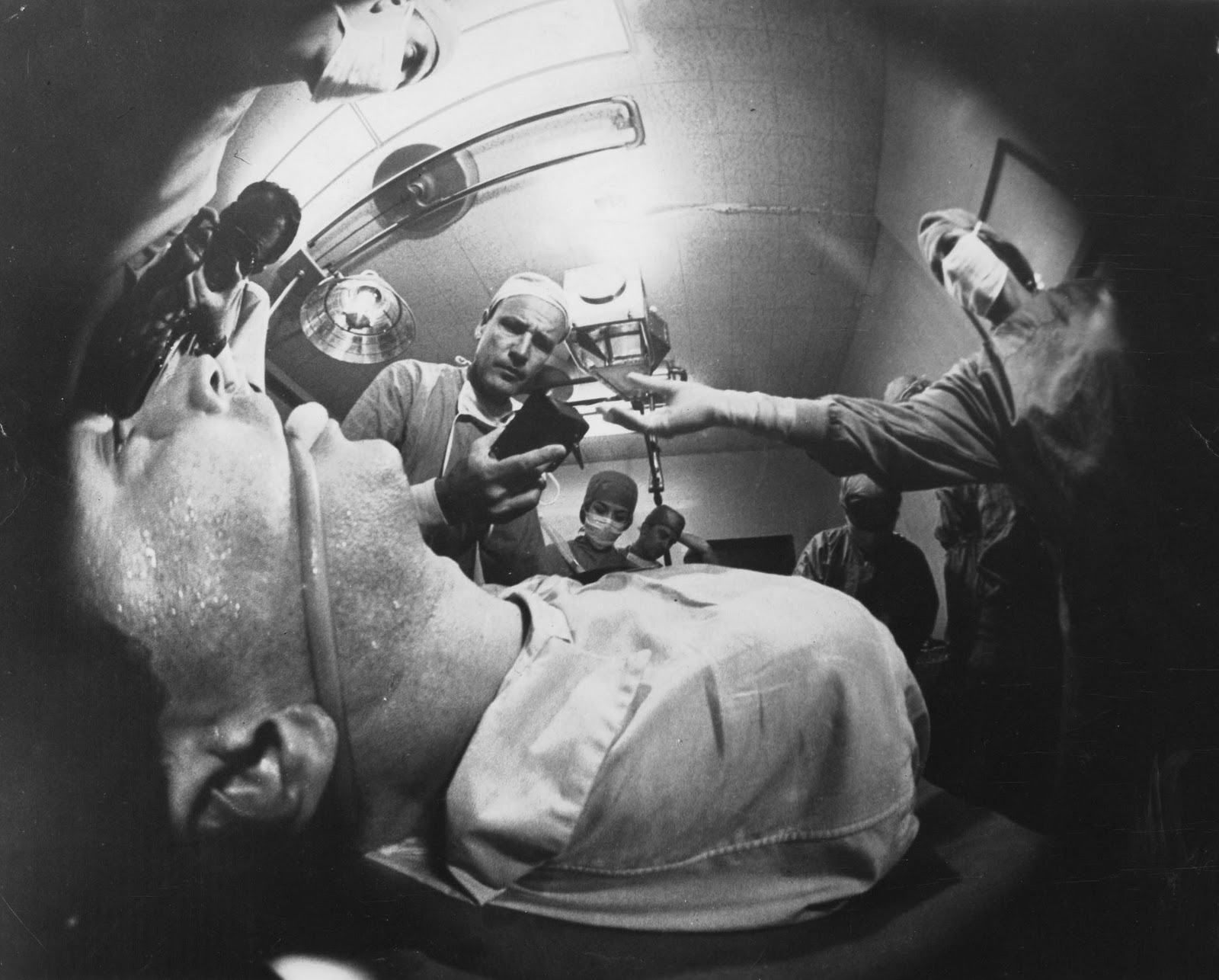
Seconds was my introduction to the genre, so I will discuss that briefly, and then discuss the implications of the genre's persistence in the international film community. The first act of the film is primarily concerned with establishing Arthur’s suffocating, claustrophobic existence, emphasized through the technique of upward angles upon upward angles, and close ups that put us in such proximity to our subjects’ faces that we are made uneasy. Arthur is contacted by a mysterious company and given the chance at a new life with a new face. Although he is initially apprehensive at the moral consequences of abandoning his family and other obligations, Arthur is ultimately willing to do this for the opportunity of a new identity.


At the end of the second act of the film, Arthur (now Tony) finds himself at a harvest festival. He finds himself unwillingly stripped and dumped into a grape-crushing vat filled with beatniks. Here, we see Arthur transcend his identity expressed in the form of increasingly ecstatic editing of writhing bodies, stomping feet, faces, bodies, and light peeking through the branches and vines until we the viewer become entangled in the seething mass. Arthur has finally let go of himself, losing himself in the crowd.


Transcendence of ego serves as a goal for many religious/spiritual/occult practices. It is widely acknowledged that transcendental meditation becomes increasingly effective in large groups, where people can feed off of one another’s energy. Arthur gets a brief glimpse of this pure consciousness, as a part of the seething mass of hippies, but after the moment, it is gone, and Arthur finds himself trapped again, by the cage of his new created identity.


It seems that this willingness, or even eagerness, to shed one’s identity ties in with one of the most common clichés in cinema, which is the idea of “Let’s run away and start all over again.” This is ultimately what our protagonist’s decision amounts to: escaping from himself in hopes that the new beginning will provide a fresh start with no burdens of past guilt or obligation. As viewers, we see that this is naïve, as obviously this decision is what ultimately seals these characters’ respective fates. This is interesting, because it holds up a mirror to the audience, who are also attempting an escape from reality, if only for the short duration of the film. It would seem that there are parallels to this act in the act of losing connection with one’s appearance through plastic surgery (one’s face is intimately connected to identity).


Surges in popularity of cinema at times of financial instability are a testament to cinema’s great potential as a means of escaping the drudgery of day-to-day existence. Bertrand Russell suggests that as a society, we have tried to divorce ourselves from our animal instincts, and thusly we have a spiritual void that we hopelessly try to fill with pale mimicries of primitive human behavior. Perhaps some or all of this factors in to the existence and persistence of this cinema across genre and cultural boundaries.


The face transplant theme, which pops up over and over again, albeit rarely, reflects all of this. This theme became of particular interest to me after watching Delmer Daves’ Dark Passage in close succession with Seconds. In Daves’ film, Bogart makes a statement (after his own dramatic plastic surgery, and a whole new set of problems), that he just wants to get away “To somewhere nobody knows my face.” This captures, in essence, the nature of this strange cinema. We want to run away, and in so doing, just create new things for ourselves to run away from. After all, it would appear that we, and all of these characters, are really just trying to escape from ourselves.

Tuesday, November 23, 2010

Ossessione

This review comes in lieu of my originally scheduled Sudden Fear review.  I watched this film a second time for my Italian class, so I figured I would post some brief thoughts of the film on here.  Perhaps I will at some point review some of the other adaptations of the source material, though the story is, I suppose, an archetype.

Luchino Visconti's first film as a director was 1943's Ossessione, an adaptation of James M. Cain's novel The Postman Always Rings Twice.  The film was deemed too controversial, and was destroyed by Italy's fascist government after just a handful of showings.  Fortunately, Visconti managed to hold onto a copy of the film's negative, from which all currently existing copies of the film were made.  This film is a real cinematic treasure, and we are fortunate that it was not lost to censorship. 

The plot is simple enough:  Gino is a drifter who winds up in an affair with Giovanna, the wife of a country innkeeper, Bregana.  Gino is a rolling stone, and he develops a case of wander-foot, convincing Giovanna to come and hop a train with him.  Giovanna gives up quickly, and returns home, while Gino continues on to another town alone.  Gino takes up with another vagobondo, Spagnolo, who encourages Gino to live his life freely, and to forget Giovanna.  Spagnolo serves as metaphor for the freedom of the open road, contrary to the metaphorical cage Gino finds himself in after breaking with the Spaniard and falling back in with Giovanna after a chance encounter.  With the exception of Spagnolo, all of these characters are doomed and all are fools. 

Ossessione is a dark and moody early noir.  It is easily one of my favorite in the genre.  Required viewing for fans of Italian cinema, film noir, 40s melodrama, and by people who love cinema.

Wikipedia has a pretty good entry on this film, which I highly recommend checking out (wait until after you view the film).  Particularly this section on "cinematic technique" which consists of excellent technical insight, as well as deeper general insight into the film.

Monday, November 8, 2010

In a Lonely Place

Gloria Grahame plays Laurel Grey, the sexy new neighbor in Bogey's apartment complex.  Humphrey Bogart is Dixon Steele, a script writer whose career as a Hollywood screenwriter is in the dump.  When "Dix" is accused of the murder of a young female visitor, Laurel provides his alibi.  A romantic interest develops between the two in the weeks that follow (culminating in a hasty engagement), but Dix begins acting increasingly cruel, violent and erratic, all the while the police (and eventually Laurel) suspect him of murder.

Nicholas Ray's 1950 noir does an incredible job of stringing the viewer along, questioning Dixon Steele's innocence.  He clearly has issues, as demonstrated by his short temper, violent rages and controlling behavior.  As the film progresses we see his true character unfold piece by piece, and only at the very end of the film are we given any answers.  Though a later noir, In a Lonely Place is highly original, and a much better watch than some other noir "classics" like Scarlet Street (1945, Fritz Lang).   The film is not without its flaws, however; it isn't as gritty or tough as other genre pieces, and was surely cranked out by the studio.  The film makes up for its faults by compelling the viewer to press onward, in hopes of penetrating the mystery surrounding Bogart's Dixon Steele.

Overall, In a Lonely Place is pretty decent studio noir with excellent performances across the board.  Bogart is in top form here, and in spite of this being a lesser talked about film than other [obvious] roles in his career such as in Casablanca, The Maltese Falcon, and The Treasure of the Sierra Madre, this is one of his better performances.  Grahame is also great, but her character seems to become weaker as the film progresses, which is somewhat of a detractor from the film.  There are some really dark scenes, like the scene where Dix narrates his version of the murder of which he is accused.  As it is acted out in front of him, he becomes increasingly stimulated as the audience is made to feel increasingly uneasy.  Also, some really wonderful dialog from Robert Warwick as a washed-up actor friend of Dix, and a harrowing car ride sequence in which Bogart and Grahame just deadpan into the camera.  While In a Lonely Place isn't quite as bleak or stark as some other noir pieces, and isn't the absolute best the genre has to offer, it is still highly suggested film noir viewing. 

From Wikipedia:
Louise Brooks wrote in her essay "Humphrey and Bogey" that she felt it was the role of Dixon Steele in this movie that came closest to the real Bogart she knew. "Before inertia set in, he played one fascinatingly complex character, craftily directed by Nicholas Ray, in a film whose title perfectly defined Humphrey's own isolation among people. In a Lonely Place gave him a role that he could play with complexity because the film character's, the screenwriter's, pride in his art, his selfishness, his drunkenness, his lack of energy stabbed with lightning strokes of violence, were shared equally by the real Bogart."

Up Next: Joan Crawford & Jack Palance in Sudden Fear